The business of war

This year is the 50th anniversary of a great book but one that relatively few people will have heard of. It was called ‘Report from Iron Mountain – on the Possibility and Desirability of Peace’ and it was a spoof. At that time there was almost a fashion in think-tanks, like the Rand Corporation, producing studies for governments and industry on current trends and possible futures. Iron Mountain, or more fully ‘Iron Mountain Atomic Storage Corporation’, was real – it was a depository for business records, set up in a former iron mine outside of Boston, for those corporations who hoped to carry on trading after a nuclear war. This was in the 1950s. The firm is still going and has branches around the world, including in the UK, but now of course most of the data is digitised. This name gave the book, which really was a slim volume, credibility as a genuine think-tank report. Its subject, as the subtitle shows, is an interesting one – it was not just a question of the possibility of peace but also its desirability. But surely peace is always desirable?

The book answers that question early on because the premise of the book was ‘business as usual’. The question then was ‘is peace compatible with business?’ The difficulty is that under capitalism capital needs to be destroyed periodically to allow for renewal, reinvestment and more profits. This analysis is basically marxist and, though the book didn’t point that out, American business has been aware of its truth for a long time. The main mechanism for the destruction of capital, the argument ran, is war and in fact we live in a warfare state. However simplistic that sounds, you only have to watch the news. So for peace instead of war, a replacement must be found for that function. The book considers three principal options.

The first, and most popular with liberals, would be a massive programme to bring living standards in the ‘3rd World’ up to the levels we enjoy in the West. However it is is soon dismissed because, while vast amounts of investment capital would be required to to bring this about, it would then plateau and would not deliver the destruction of that capital needed to maintain the capitalist system.

The second option was another massive programme to explore and possibly colonise the rest of the solar system. This has had its proponents recently too. But it would suffer the same problem – an even more massive outlay of capital but then nothing more – just another plateau.

The third and winning option I would summarise as an ongoing series of managed environmental disasters. To quote the book, ‘Nevertheless, an effective political substitute for war would require “alternate enemies”, some of which might seem equally farfetched in the context of the current war system. It may be, for instance, that gross pollution of the environment can eventually replace the possibility of mass destruction by nuclear weapons as the principal apparent threat to the survival of the species. Poisoning of the air and of the principal sources of food and water supply is already well advanced, and at first glance would seem promising in this respect; it constitutes a threat that can be dealt with only through social organization and political power. But from present indications it will be a generation to a generation and a half before environmental pollution, however severe, will be sufficiently menacing, on a global scale, to offer a possible basis for a solution.’ Sound familiar? The advantage of this over the other two is that the destruction would be ongoing and, hence, would keep capitalism running.

Now I’m not suggesting that this is already happening, but I am hoping no-one thinks of mentioning it to D Trump. Of course, what ‘Iron Mountain’ deliberately avoids considering is the ending of capitalism as well as warfare. To quote the book again. ‘War is not, as is widely assumed, primarily an instrument of policy utilized by nations to extend or defend their expressed political values or their economic interests. On the contrary, it is itself the principal basis of organization on which all modern societies are constructed.’ How does that make you feel?

I have massively compressed and simplified the arguments in this work, which is much more cleverly constructed to look like an authentic study for a US government deeply entangled in the Vietnam War and heading for the near-global revolutionary upsurge of 1968. Many people still believe it’s real. If you want to check it out for yourself, it can still be bought on line or downloaded. Happy trails!

RA 21.6.17

“It’s survival of the fittest”

This is used as a ‘scientific’ justification for unbridled competition and ascribed to Darwin. In fact he didn’t say it, that was Thomas Huxley in support of Darwin. What those who repeat this line overlook is that Darwin was talking about species, not individuals, and success in reproduction, not the Olympics or the market.

Swings and roundabouts

I’m starting this just after midnight on election night and the pundits are panicking (looks like bookies are better at it). If I have any readers, you might be thinking that my last post showed I was equally adrift but I don’t think so. JC got a better showing in the campaign than he’s had previously but the make-up of the Labour Party hasn’t changed yet. To be honest, I hoped it would be wiped out and most of the Blairite hacks gone. If they’re still in their seats, then I reckon my assessment of the future has yet to be disproved unless .. a good result makes them recalculate their view of their leader. I’d be happy with a hung Parliament (trying to ignore visions of lamp-posts in Parliament Square) with a weak Tory government and a strong Opposition of different parties that actually stop their more vicious policies. The best outcome would be the public waking up from its zombie condition and becoming politically active. Much is being made of the youth/student vote – reasons to be cheerful. Yes, I’m an optimist really. Opposition is useful!

I’m puzzled that the SNP has lost so much support but even more that the Tories have gained at the nationalists’ expense when the Scots weren’t in favour of Brexit. I’m too far away to know what that’s about. Apologies to any friends in the North.

Resurrection time ..
JC lives! .. despite the best assassination attempts of his colleagues. Will his disciples do a better job this time? Mandelson leads the recalculation with his familiar ‘No Labour’ refrain that, to get into power, they need to win over Tory voters. That’s not why they got 40% of the poll this time. Will Jeremy keep steering left? Ask your bookie.

The May Queen got herself well tangled up on her pole (’scuse the pun) but, if I were to wear my most cynical hat, I might suspect she planned to lose so that Labour got lumbered with the EU negotiations and catch all the flying smelly stuff that’s going to come with that. Whatever – now is not the moment for the rest of us to relax.

RA 9.6.17

Socialism doesn’t work

The fact is it’s never had the chance to, that is beyond small communities and businesses. On the level of a nation state we’ve only ever had partial attempts that tried to co-exist with a capitalist economy or worse, as in one-party/one leader dictatorships like the USSR under Stalin or the Chinese Peoples’ Republic under Mao Zedong. Socialism does not mean nationalisation and total state control. However, like christianity, the movement was taken over by power junkies as soon as it showed promise and the term became tainted with their policies. The best description of what it could be is in the famouse Clause 4 of the Labour Party’s constitution that was dumped by ‘New Labour’: ‘To secure for the workers by hand or by brain the full fruits of their industry and the most equitable distribution thereof that may be possible upon the basis of the common ownership of the means of production, distribution and exchange, and the best obtainable system of popular administration and control of each industry or service.’ Written by Sidney Webb, one of the original right-wingers in the party, this was long regarded by most members as Labour’s ‘bucket list’ at best. ‘Common ownership of the means of production’ became nationalisation, though that’s not the only possible meaning – the co-operative movement had another, ‘workers’ control’ is another. The slogan of socialism became ‘evolution not revolution’, which overlooks the fact that evolution proceeds by revolutionary jumps and no fossils of intermediate species (ie giraffes with longer and longer necks) have ever been found. It’s also rarely mentioned that the first people to call themselves social democrats were Marx and Engels’ organisation (I bet someone corrects that) and so did Lenin, Trotsky & Co – the Communist Party came later.

RA May Day 2017

The Labour Party – a post-mortem

The British Labour Party – born 1900; died 1995 – was a coalition of different tendencies. This is pretty much the standard model of political parties in liberal democracies and these divisions are always a source of internal tension and power struggles, which usually subside if that party comes to power but surface again when in opposition. Generally though, parties that do get into government tend to hold together despite the cracks.

However the Labour Party in the UK was unique in its mixture compared to similar parties elsewhere. Whereas most European social-democratic parties had some kind of marxist basis 1, the Labour Party differed in that the UK already had a strong trade union movement that was indigenous and not much influenced by Marx or marxist thinking. The UK also differed in that in the last half of the 19th century, the Liberal Party had been seen as the defender of working class rights and interests. But by the end of that century the limitations of that relationship were showing more clearly as the mass trade unions, like those of the railway workers and miners, became more powerful than the older ‘craft’ unions. As the pressure for a voice for workers in Parliament increased, those Liberals who favoured ‘social’ liberalism over economic liberalism joined with trade unionists and socialists (social-democrats) to form the Labour Representation Committee. This was the body that grew into the Labour Party.

So, from its inception, the Labour Party was a reformist one and at times has included or worked with groups, like the Independent Labour Party (ILP), the Co-operative Party and the Fabian Society. Its constitution was famously written by two Fabians, Sydney and Beatrice Webb in 1917 and adopted in 1918. The Webbs, like all Fabians, were avowedly reformist, despite their admiration of Lenin and the Russian Revolution, nevertheless they included in that constitution the famous Clause 4:-

“To secure for the workers by hand or by brain the full fruits of their industry and the most equitable distribution thereof that may be possible upon the basis of the common ownership of the means of production, distribution and exchange, and the best obtainable system of popular administration and control of each industry or service.”

This short declaration of intent became the battleground for nearly all the future battles between the left and the right of the Party.

The centre of the dispute was the phrase, ‘common ownership’. For the Webbs and many others it meant nationalisation, for the Co-op Party it meant co-operatives, but for many left socialists it meant full workers’ control. Many within the Party saw nationalised industries and services, preferably under a Labour government, as the same thing as workers’ control.

I’ve seen a photo of a group of miners setting up a signboard outside their pit in 1947, which read: “This colliery is now under worker’s control”, whereas the ‘truth’ was shown in the one below.
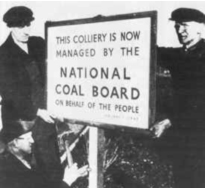

In fact both groups of men were as deluded as the Russian workers who thought that the ‘dictatorship of the proletariat’ meant they were in control. ‘On behalf of the people’ here meant, as in Russia, on behalf of the government. In other words, state capitalism.

As long as business is good, state capitalism seems to work in the workers’ favour, but they have no say as to the use of profits, the investment of more capital or the development of the industry. The classic case was the GPO, which successive governments milked, whether or not it made money, and hid that extraction from the public when calculating its ‘losses’.

On the other hand, workers didn’t help themselves much either. Trade unions fought for their members interests first and foremost 2 and rarely co-operated. This was reinforced by the ‘closed shop’ which was intended to safeguard unionised workers from having their wages undercut by non-union workers. Instead it led to constant ‘demarcation disputes’ about who had the ‘right’ to a particular job. It also created resentment among those unemployed workers excluded from work. The trade unions in the UK never had ‘too much power’ but they did become inward-looking and self-satisfied. Too often they failed to react to new technologies in time or to keep the public on their side until it was too late.

When the Tories under Margaret Thatcher came to power in 1979, they had their plans to destroy union power in place. Using the right-wing press as their shock troops they pinned the economic downturn, caused by the steep price of oil when OPEC 3 was formed, on Labour and the unions. Cameron and Co have done exactly the same with the collapse of the banks in 2008. In both cases this has left the Labour Party speechless with panic, so it turned on its own left wing for a scapegoat.

If the right wing of the party consists of liberals and reformists who believe in accommodation with capitalism and getting workers the best ‘deal’ they can, the left is, or was, a more varied mix. It included militant trade unionists, left socialists who believed in the gradual achievement of Clause 4’s aims by ‘evolution not revolution’ and, by this time, various Trotskyists. The biggest group of these were organised in Militant Tendency, though there were others, notably the International Marxist Group (IMG, aka the ‘Migs’).

These groups were mostly the product of the near-global revolution of 1968. That year was the high point of radicalism that had spread across the world following WW2, driven by the liberation wars of colonial peoples, civil rights struggles of minorities and a general rejection of the political status quo – especially of the so-called Communist Party, but also the social-democratic parties. But, while the latter were seen as part of the problem, some at least, like the UK Labour Party, could be pushed into making useful legislation. However, with the defeat of those uprisings in France, Czechoslovakia and the USA, militants who still believed in political revolution looked for other tactics. Trotskyists, who saw themselves as the true heirs of Marx, in the UK began a programme of ‘entryism’. This involved joining the Labour Party, not with the intention of taking it over, but pushing a left-wing agenda and ultimately recruiting as many of its disaffected militants as possible before leaving with them and setting up a ‘real’ revolutionary party. Unfortunately their ‘analysis’ of the situation in 1980s Britain failed to take account of the forces against them and the lack of fight amongst the working class. They became the best target the Labour right had had since the Communist Party in the 1930s.

The settling of accounts came in 1986. One bunch of right-wingers had already jumped ship in 1981 and set up the Social Democratic Party, unconscious of the irony that the first with that name was founded by Karl Marx. Then the right sat back and let the triumphalist left write the manifesto for the 1983 General Election. This reasonable, if hopelessly optimistic, wish-list, dubbed by Gerald Kaufman as ‘the longest suicide note in history’, was then blamed for the party’s third defeat in a row. Everyone else knew that had been caused by Thatcher’s ‘victory’ in the Falklands War.

So, at the Labour Party Conference in 1985, Neil Kinnock declared war on Militant Tendency. Those who did not renounce the faith were soon expelled. The right wing of the party had finally won and awarded themselves a red rose to celebrate the fact (thus alienating all their supporters in Yorkshire). Nor was this their only error. Not only did they get rid of those invasive Trots, they also lost most of their young activists who were in touch with the ‘grass roots’ – not perhaps the Labour hard core voters and trade unionists who still had jobs, but all the rest whose lives and livings were being decimated by Thatcherite ‘monetarism’ and the mass exodus of capital and industries to cheaper off-shore havens of exploitation.

The defeat of the Tories in 1997 was misread by the right as a vindication of their policies. They followed up Kinnock’s ‘New Realism’ – neither new nor realistic, just the mantra that they’d never win again without middle-class votes – with New Labour. A wave of, mainly university-bred, MPs and ‘advisors’ took over in the sure belief they could run capitalism better than the Tories. For a while they did.

Sadly, in fact, Labour was already dead. At the party conference in 1995, they had ditched Clause 4 and with it any pretence that they were a party of ‘labour’. They had watched as the Tories wiped out whole industries, sold off nationalised ones, sold off council housing to tenants, sold mental hospitals and school playing fields to ‘developers’, destroyed the National Union of Mineworkers and outlawed any effective industrial action by other unions. When they got back in power under Blair, none of this was reversed. Furthermore they had colluded in the enforcement of the Poll Tax until mass action broke it down. Ignoring the haemorrhage of working class activists and belief, they put their faith in ‘floating voters’ and the residual traditions of sympathy in the once-upon-a-time industrial heartlands.

They’ve lost the plot and don’t know where to look for it. The slaughter of their Scottish MPs in the election of 2015 was not a result of rising nationalism – the referendum made that clear – but a total loss of any trust in the Labour Party to defend them from the Tories’ depredations, whether in power or not. The Labour leadership weren’t even able to defend themselves from the ludicrous lie that they, and not the casino banks, were responsible for the economic collapse since 2008. They weren’t because Gordon Brown had made it clear in 1997 that he would be continuing Tory economic policies. To admit that would be to reveal how far right they’d moved. There’s nothing left to choose between them and the liars and thieves running the country. Small wonder that many working class voters looked to UKIP’s clowns to save them from redundancy and penury.

I see little hope for the future of that corpse being revived. In the last two years there has been a major revival of Labour’s membership under the leadership of Jeremy Corbyn. To the horror of the Labour right wing, the left has returned stronger than ever but they refuse to accept it. They’re totally glued to the idea that a socialist Labour Party in unelectable and are doing everything in their power to stop Corbyn and his supporters in their tracks. So far, apart from saying so out loud in public, they’ve collaborated with zionist activists to accuse of anti-semitism any critics of the Israeli government’s policy of apartheid and ethnic cleansing in the West Bank. They’ve even tried to accuse the Trotskyists of trying to take over the party again, even though they’re shadows of their previous selves. No trick is too dirty to use. Corbyn, meanwhile, continues to try to hold the party together and, outnumbered by his enemies in Parliament rolls over and reluctantly agrees with the right’s policies and lies. Unless he finds his backbone, the Labour Party isn’t just a headless chicken, it’s a gutless one too.

ra 10.5.15, updated 1.5.17

1 Although many European socialist parties still have their roots in marxism, the rise of the Communist Party after the Russian Revolution saw them all rejecting it and any attempts at revolutionary change.

2 This was almost always built into their constitutions, which saw their rôle as solely looking after the interests of their members within the current system and nothing more. So they’ve had no other agenda beyond fighting for more pay, improving conditions of work (rarely) and hanging on to jobs and old practices in the face of changes in their industries and services. The NUM, the union with the best record of defending other workers, especially nurses, was crushed with Labour’s approval. The Tories had managed what Barbara Castle and ‘In Place of Strife’ had failed to do.

3 The Organisation of the Petroleum Exporting Countries, who had organised themselves for the first time to get a fair price, instead of letting the oil companies continue to rip them off.

Disclaimer: the above is a personal and frankly partisan (not party) opinion piece of someone who lived through the second half of the 20th century and been on the fringes of some of the events described. Historians and partisans of other credos will undoubtedly trash it. Good luck with coming up with a better one.

“Political correctness gone mad”

Some people keep grinding this out like they know what they’re talking about, but I dare anyone to say what they want in its place. ‘Call a spade a spade’? Well, say it in the right place and see what the reaction is.

I’ve heard a slightly different version of its origin recently but prefer the one I first read, that it was a put-down by reactionaries to attempts by students at the University of California to stop people using racist language freely as if it were protected under ‘freedom of speech’. As far as I’m concerned it wasn’t, or shouldn’t have been, intended to ‘purify’ the language but rather a consciousness-raising way of realising who you’re insulting and the effect it has on them. If you still think it’s OK to use an old term for people of colour then say it out loud, or try the phrase “All Muslims are ..”, in a situation where you’re outnumbered by members those different groups. See how brave you are.

No-one is saying you can’t be critical of someone of a different ethnicity or religion or ideology, just be careful you’re not ‘tarring everyone with the same brush’, to use another old racist phrase. It’s not just impolite or bad for your health, it’s untrue.

RA 25.3.17

Getting flocked

The vultures are joining Donald Trump (hereafter known as DT – delerium tremens) at the feast. So far Farrage and Gove. Who’s next? Marine Le Pen? Berlusconi? Every other sociopath and neo-fascist on the block? Even that Nobel Prizewinning war criminal and friend of Putin, Henry Kissinger, got in on the act. Opposition is growing but there’s no reason to relax – the last time we were here was the Reagan-Thatcher axis and we’re still living with the consequences of that nightmare. At least the Wicked Witch of the West put a dent in our home-grown fascists’ aspirations by nicking their policies. Now they could be partying on the White House lawn.

Every sane person is fearful of the prospects for the future but that’s not enough – we need to get organised. As the old Berlin anarchists slogan said, ‘Tu wat!’ – Do something. So look out for who’s running your favourite campaign and join it .. or start your own. Resistance is useful.

RA 20.1.17

Multiculturalism ..

.. has had a bad press in recent years and, personally, I’m not surprised. 30 years ago there was a major debate on the Left and in the Labour Party as to which was the best approach to dealing with the racism endemic in this country, multiculturalism or anti-racism. I favoured the latter and this is why.

I love living in a multicultural and multi-ethnic country. It was part of our national DNA long before the slave trade made racism a necessary excuse for treating other human beings as beasts to be slaughtered or worked to death. As post-war immigration brought more and more of those formerly enslaved or colonised peoples to this country, racism fell out of fashion amongst most of the political class, with significant exceptions. Those immigrants brought as much of their home cultures with them as they could and this led to some frictions with the local populations. Likewise there were and are aspects of our ‘British’ culture that did not sit well with all those incomers. Multiculturalism was supposed to be the answer to this clash by suggesting that each community should live by its own values without interference, except where these broke ‘our’ laws. I shouldn’t need to list all of the times this has gone wrong, from female genital mutilation to ‘honour killings’ and child sexual exploitation. Those examples may seem to be one-sided but, interestingly, the authorities have had less difficulty in trying to suppress Afro-Caribbean activities like smoking ganja and shooting each other (there’s an element of cause and effect there – not the smoking but the suppression).

Consequently a parallel debate has arisen between ‘integration’ and ‘assimilation’. Too many people think they mean the same thing but they don’t. Integration is a two-way process of people from different backgrounds learning to understand each other and live together. Assimilation means that the newcomers must become identical with the residents. Like the British did in India and Africa …

What the white British people needed to learn, and are still groping their way towards, is an understanding of their prejudices and how to deal with them. In a nutshell, when you hear the phrase “I’m not a racist but …”, you know that what follows will be a racist statement. It would be better to say “I am a racist but .. I’m trying to learn not to be one.” Meanwhile those new communities still clinging to their old cultures need to realise that, while they have a right to their own beliefs, in this country they do not have the right to impose them on their families or other members of their community. Tough lessons all round and a way to go but we can still do it.

RA 25.3.17

I wonder lonely as a nail,
proud upon a camping chair.
While passing sirens howl and wail
I shelter from cold eastern air
here upon this low green hill
beside a bunch of daffodils.

Not Wordsworth’s thousands, dancing free,
but their brassy garden counterparts
pretending to act naturally
and, like tributes bought from supermarts
then rammed into this parkland soil,
they fool no-one – wasted toil.

I resent the space they take
where in my lunch break I would sit –
spring tinsel for the strollers’ sake
but, for my part, they look shit
and crowd right out the native flowers
that sometimes lighten my dark hours.

But, in fact, I can’t complain –
this is man-managed space
where all’s arranged and that is plain
as the manicured beard upon my face.
Where are all the wild flowers gone?
Gardeners stole them everyone.

rs 1.4.14

“We’ll never be part of a federation”

Gordon Brown (remember him?) has suggested a compromise solution to the argument over the SNP’s demand for another referendum about independence for Scotland to make it a federal partner of the UK instead. Seems an idea worth considering but a big no-no for the Tories under Thatcher was becoming part of a federal Europe. This feeling among the idiots in British politics resurfaced in the EU referendum last year. It seems to have escaped their notice, however, that we already live in what is really a federal state. I know it’s called a union, but that’s increasingly becoming a misnomer as the different parts seek even more independence than they had before and don’t forget that Scotland had different education and legal systems and its own currency long before devolution, while Northern Ireland even had its own parliament. In fact England began life as a federation of separate states and regions before the Normans invaded and those differences didn’t disappear overnight. So there’s nothing to be afraid of in getting closer to other peoples or in giving them more autonomy to govern themselves. ‘Sovereignty’ is a fiction in a world dominated by global capitalism. It only becomes real when you claim your own and join with like-minded folk to assert it.

RA 18.3.17